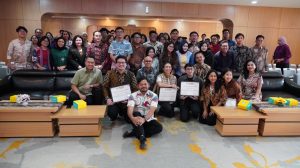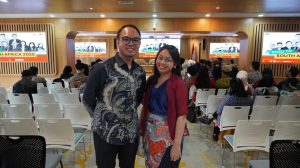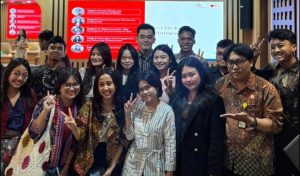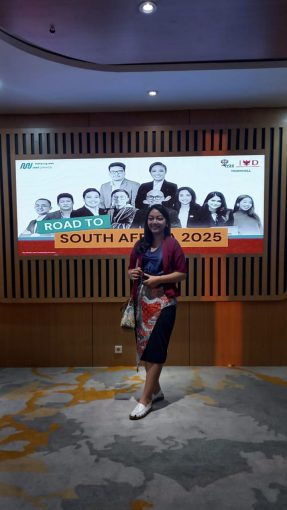
Prienta, a Double Degree student of the Master of Urban and Regional Planning (MPWK) Program at UGM, was selected as one of the delegates for the Youth Townhall Road to Y20 Indonesia 2025, held on August 2, 2025 at the Jakarta Library Hall, Taman Ismail Marzuki. This activity was part of the Road to Y20 Summit series leading up to the Y20 Summit in South Africa, serving as an important forum to gather the voices of Indonesian youth before being brought to the global stage.
The Youth Townhall was initiated by Indonesian Youth Diplomacy (IYD), a non-profit youth organization joined by Prienta. IYD is the official body responsible for selecting and facilitating Indonesian youth to participate in the Y20 Summit, the official Youth Engagement Group of the G20 Leaders Summit, as well as serving as the Youth Focal Point to the Republic of Indonesia’s G20 Sherpa. Prienta was motivated to participate due to the participatory nature of the program, which focuses on listening to youth voices through focus group discussions and consultations, later compiled into a communiqué to be presented at the Y20 Summit in South Africa. “This activity clearly shows that it can bring the voices of young people from the grassroots to the international level, quite literally and directly,” she said.
During her participation in the Youth Townhall, Prienta proposed a complementary policy of gender mainstreaming supported by relevant infrastructure and facilities. She emphasized that gender mainstreaming policies, which promote the increased role of women in the workforce, must also be accompanied by physical facilities. Examples she highlighted include the provision of daycare centers in workplaces, lactation corners at strategic points, and women-friendly toilets, including in labor-intensive sectors.
She cited the situation of female workers in oil palm plantations in East Kalimantan, who often lack access to basic facilities such as toilets. This condition significantly limits employment opportunities for women in the area, making the workforce predominantly male-dominated. She also emphasized the importance of having daycare stations near workplaces to support working mothers.
The topic she raised aligns with her thesis research, which explores the impact of spatial inequality—such as levels of urbanization—on women’s labor force participation. Her academic interest in gender equality and community-based planning has encouraged her to actively engage in this forum. She views the participatory approach of the Youth Townhall as tangible evidence that global policy planning can still incorporate grassroots voices, including those from marginalized communities.
Prienta’s proposal strongly connects with the global agenda of the Sustainable Development Goals (SDGs). First, her idea of women-friendly facilities is in line with SDG 5: Gender Equality, which emphasizes equal access and opportunities for women in the workforce. Second, her call for more inclusive workplaces aligns with SDG 8: Decent Work and Economic Growth, as providing adequate facilities enables greater female participation in the labor market, thereby supporting fair economic growth. Third, her emphasis on urban planning that ensures women-friendly public facilities contributes to SDG 11: Sustainable Cities and Communities, which focuses on creating inclusive, safe, resilient, and sustainable cities.
Her participation in the Youth Townhall Road to Y20 2025 represents a tangible contribution from MPWK UGM students in the global conversation on equality and sustainability. By bringing perspectives on planning and gender justice to the international forum, Prienta demonstrated that youth are not merely policy recipients but also key actors in shaping a more inclusive development future.